
Aspandiyar Kenzhin had his sons, Mahmud, Bayazit, and Shamil, and his daughters, Sofia and Liya (Yulia). In his family history, A. Kenzhin noted that his daughter Sofia, were born in 1914 and Yulia was born in 1933, while his sons, Mahmud, were born in 1918, Shamil in 1924, and Bayazit in 1920. His wife, Zhaneta Ramazanovna (née Smolskaya), was born in western Belarus and was fluent in her native Polish, as well as Russian, Ukrainian, and Belarusian. There is evidence that Zhaneta’s parents to have converted to Islam.
As a member of the family of an enemy of the people, she was exiled and spent eight years in prison. According to her daughter, before her arrest in March 1938, she sent her older sons to Turkmenistan so they could finish school. Liya was left homeless with her younger brother. They said he was a very talented artist: he was accepted into art school without examinations, but was expelled after their father’s arrest.
Three of her sons voluntarily went to the front during the Great Patriotic War. Bayazit and Shamil never returned. Makhmud lived in Kaluga. Sofia was married to Alibi Dzhangeldin and lived in Almaty. Her son, Shyngys Alibiuly Dzhangeldin, served as the chairman of the Union of Cooperators of Kazakhstan.
When Zhaneta Ramazanovna returned from imprisonment, she visited the home of her daughter Sofia (Alibi Dzhangeldin’s wife). With her help, she found Yulia, who was in an orphanage. Since she was not allowed to live in the capital, she moved to the city of Kazaly. There, she applied for a pension in the name of her youngest son, who had died in the war, and lived on a small income. In February 1958, a notice of Zhaneta Ramazanovna’s rehabilitation arrived from the military tribunal of the Turkestan Military District.
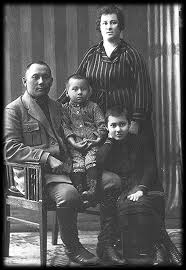
Kenzhin with his wife, Zhannet Ramazanova, son Shamil, and daughter Sophia. Orenburg, 1924.
From the family archive of Sh. Zhangeldin.
Published in the journal “Archives of Kazakhstan.” – 2008. – No. 2 (issue 6)

Zhangeldin with his wife, Sophia. Almaty, 1940.
From the archive of Sh. Zhangeldin
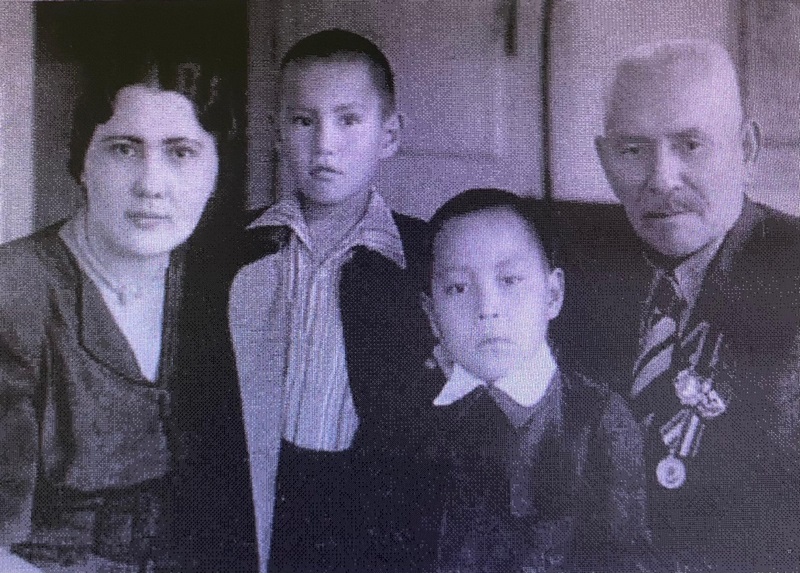
Zhangeldin with his wife Sophia and children Ali and Shyngys
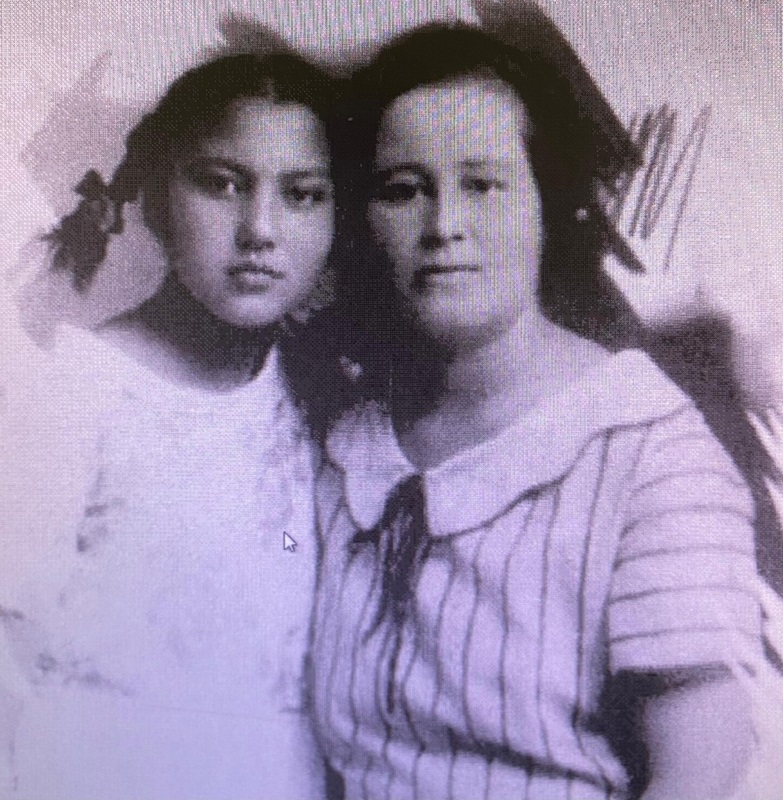
S.A. Kenzhina with her mother, Zh.R. Kenzhina.
Orenburg, (1924-1930)
From the archive of Sh. Zhangeldin
Aspandiyar’s youngest daughter, Lia (Yulia), lived in Klaipėda, Lithuania. In one of her letters to her relative, Rizuan Otepkaliev, she recalled that difficult winter. Lia was two or three years old when her father was arrested as an “enemy of the people.” It was then that she sent Rizuan a photograph of her father holding her (Lia) in his arms.
“I have very few photographs of my parents,” she wrote. “When our mother was arrested in Klaipėda, our 13-year-old brother, Shamil, was forced to take most of the photographs to the market and sell them for 10 soms. After all, we had nothing to eat, nothing to drink, and nowhere to go. When our father was arrested, my brothers carried me to the fence of the NKVD building.
Then I was sent to an orphanage for the children of the repressed people. When I grew up, I graduated from technical school. My brothers slept on park benches for a few days, and then they left for Turkmenistan. They found work there, and from there they went off to war. I saw our mother when she returned from the prison; her hair was gray, and she was old…”
After her mother’s death, Liya lived in Aktau for twenty years. After retiring, she moved to Lithuania.
Aspandiyar Kenzhin had brothers named Bekmagambet, Yesenbay, Otepkali, and Daulet, as well as a younger brother, Baktiyar. Baktiyar’s son, Abil Kenzhin, lived in Guryev and was awarded the title of “Honored Worker of Railway Transport of the USSR.” Aspandiyar’s brother, Daulet, had a daughter, Makpal, who married and lived in Aktobe. Makpal had a son, Kenes Nokin, who held leadership positions in the Aktobe region for many years.
References:
- Aronov Zhenis // Aspandiyar Kenzhin – a citizen striving for the bright path. – Almaty: “Credos Ltd C” publishing house, 2014. – 92-93 p.
- Suleimenova A. A person of destiny // Ana tili. – 2009. – February 26. – 10 p.